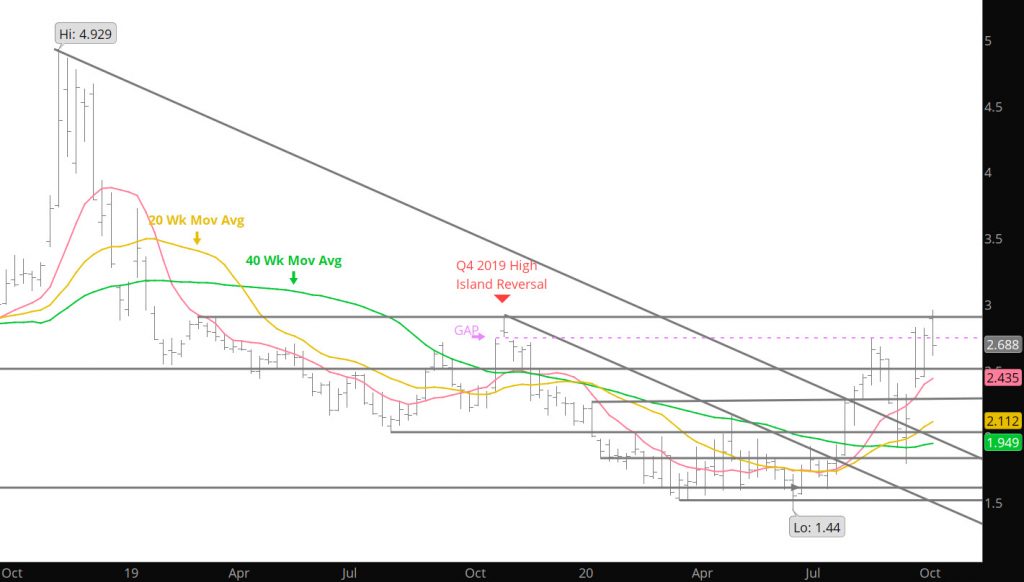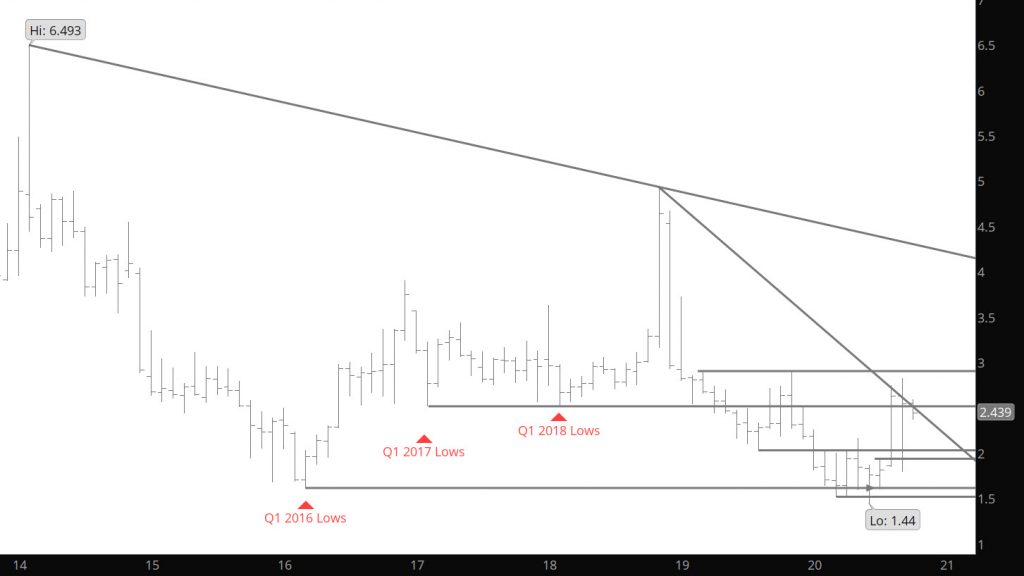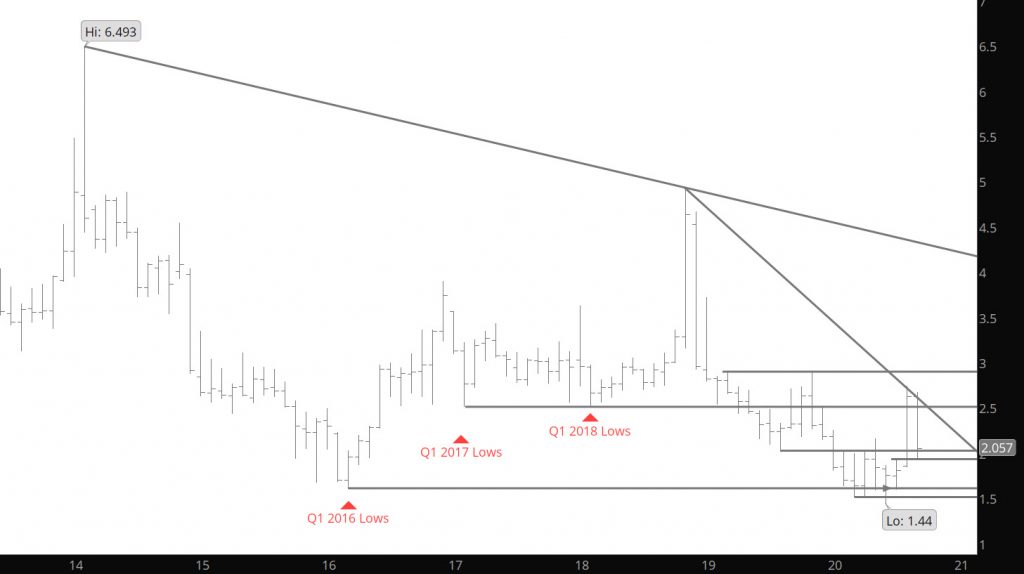
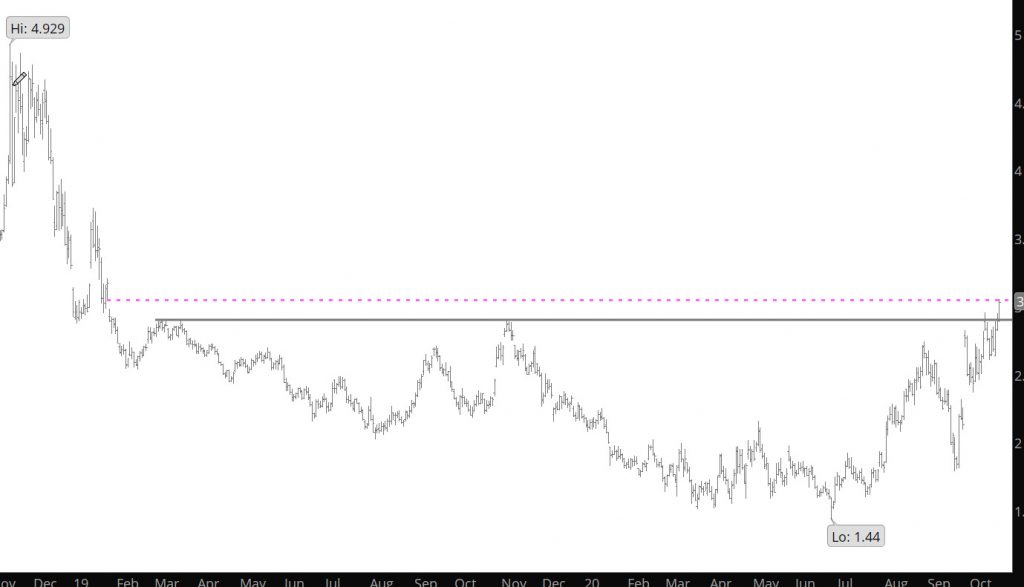
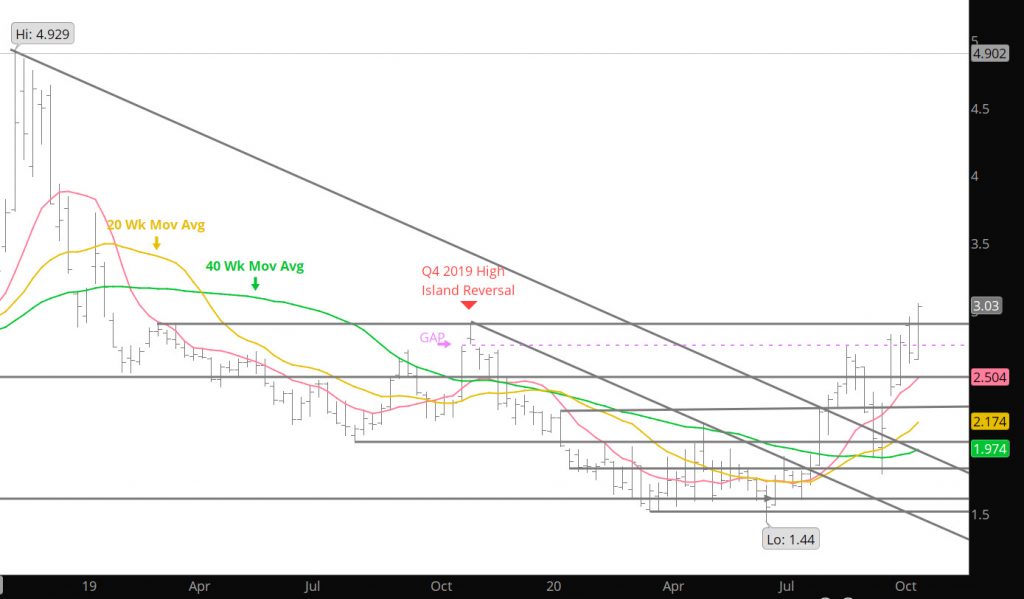
Gap in Daily Closes – Meaning

2 Year Daily Continuation
Weekly Continuation

I did not think that the gap in the Daily Chart would be filled during November trade (pink line above), but like other events I am wrong. There was never a doubt that the gap would be filled (that’s because Dec was trading north of the gap at $3.34), but filling it with November has some implications. As mentioned in the Daily, the fact the gap was closed is important but prices did not close the day above that gap ($3.047), which leaves it unconfirmed. More importantly, when the market closes above (the Nov or Dec contract) the level around $3.00-$3.04 it will then become support (what was resistance becomes support) for a potential extended period of time. That said, should Nov remain above this area, expect Dec to at least test the zone during its tenure. The longer the zone remains support it may be the base for a period of weeks.

This rally has been based on some sort of fundamental driver and should that driver be mitigated then prices may trade around this area or below for a few sessions and possibly into and through expiration. If the driver remains and this area become support then its a new world for the near term and you have to look at higher prices for resistance because a floor has been established.

To read The Daily Call you must be a subscriber (Current members sign in here. ) Start your subscription today.

September High for November Remains

Weekly Continuous

The high for November gas printed just over $3.00 in early September and while last week provided a marginal attempt to get back to that level, the rally failed reversing and closing near the lows (in fact after the regular session was finished the late afternoon traded much lower). The late declines took prices to close just about on the 10 week SMA. The week’s action occurred on lighter volume and declining open interest (highest volume on the declines).

Since prior to the beginning of November’s tenure as prompt it has presented a volatile trading range (basically +/-$2.40 – $2.90). Trade gave up the a significant portion of the substantial premium awarded at October expiration. Action then had November trading through its September low (and its 200 – day SMA) before regaining that SMA, and significantly more, when it traded to a higher continuation high at $2.955. This failure at both of the extremes suggests that the volatile range will continue through the remainder of the November contract. This price behavior will mimic other years when there has been such a significant premium.
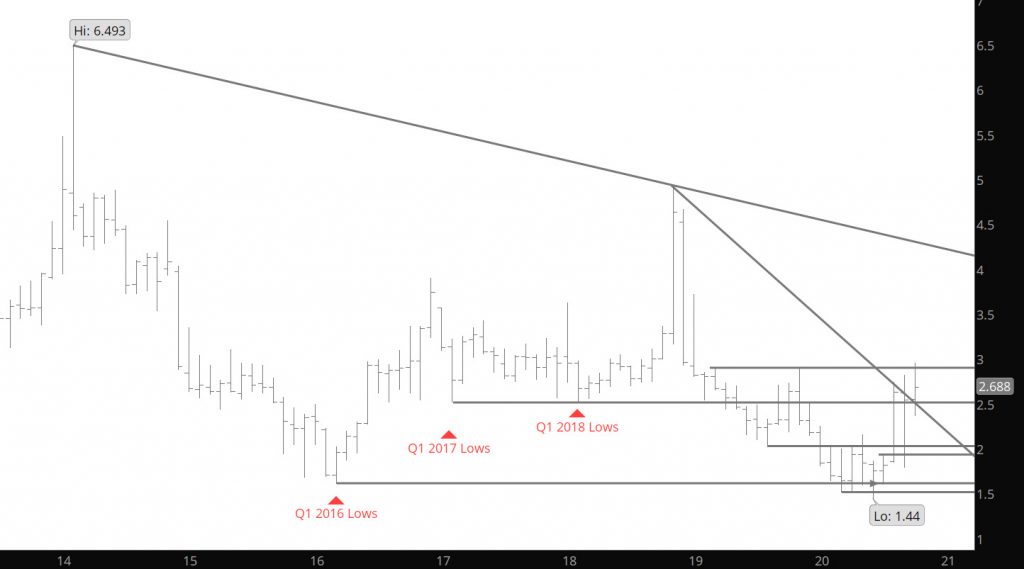
Monthly Continuation

While the Nov contract has traded in a volatile range ($+.55) this month the differed contracts have not provided the same level of volatility. December traded within a +$.35 range since the expiration of the Oct contract and similar narrower ranges occurred in the other winter differed contracts. I will be going into the open interest and volume of the differed contracts during the week so be sure to check.

Major Support: $2.476-$2.446, $2.392,$2.258-$2.253, $2.219
Minor Support: $2.618, $2.508, $2.339
Major Resistance: $2.789-$2.801,$2.908-$2.928,$2.973-$3.00

After Weak Start — Nov Firms
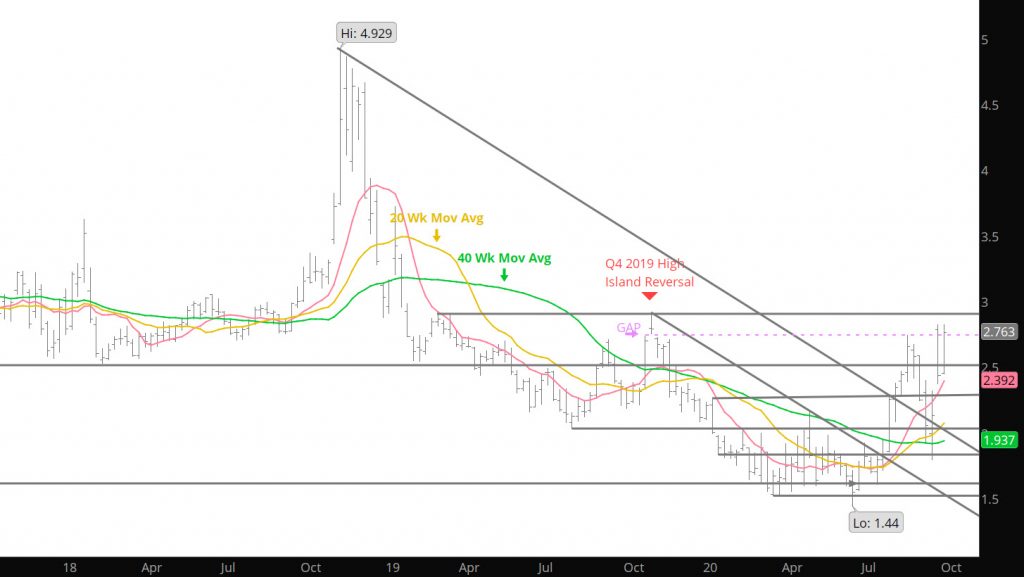
Weekly Continuous

When trading opened last week on a run and didn’t look back, rejecting the the $.369 decline of the week before and closing above the gap from last November. The market traded to the highest level since before the Nov ’19 highs but did not contain the technical indications supporting additional gains, instead they evidence shows that the rally was on short covering (more below) when prices eclipsed the 50 day SMA. Open interest in the prompt contract declined over 100,000 contracts (over 30% of total) which is significant this far before the expiration process and the fund rolling period.

Monthly Continuous

In previous discussions, there were four years when November commanded a large premium as October expired. Those four hears between ’04 and ’09 were afforded a premium between +/- $.62 and $1.47, this year’s was $.694. Each of these previous years there were some similarities to trade after the October expiration. 1) The expiration gap that resulted from the premium was reduced but the gap was not closed until the following year. The low, so far for Nov has not closed the gap from the Oct expiration; 2) the Q4/seasonal high had yet to be traded (the earliest was at the beginning of December’s tenure as prompt), this year’s has yet to be defined; and 3) November constructed a volatile trading range, The first two weeks have had above average true range.  Last week’s action left the Nov contract at a $.64 premium to October expiration where it started the month. The last week’s range continued the range expansion of the last four weeks ($.47+,$.525, $.769 and $.375) supporting the concept of entering a volatile trading range environment.

To read The Daily Call you must be a subscriber (Current members sign in here. ) Start your subscription today.

Prices Converge on the Premium to Nov
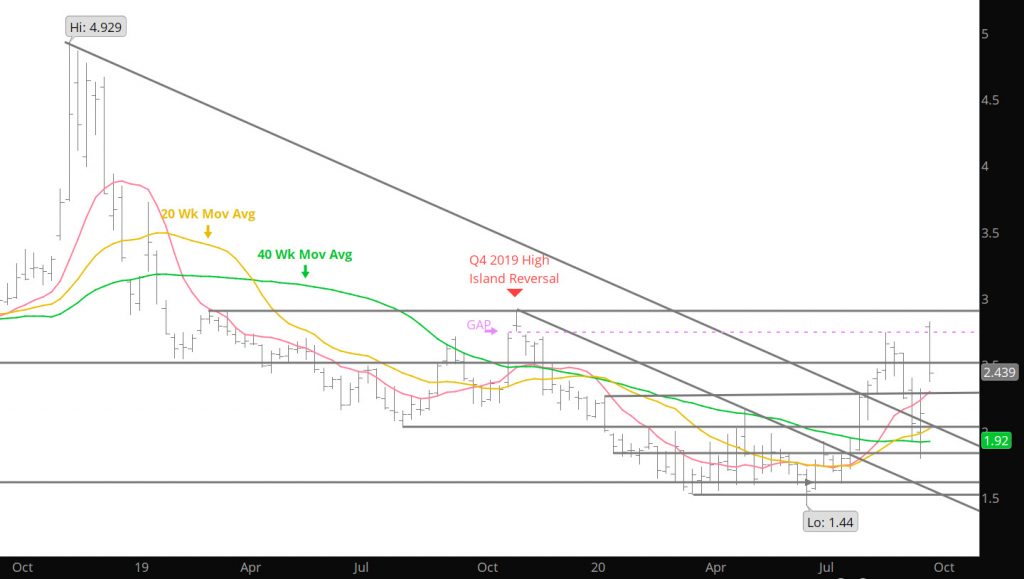
Weekly Continuation

Prices did not close the expiration gap but dove into a large chunk of the premium afforded the November contract. The declines fell short of the expiration high at $2.32 and nowhere near the October expiration at $2.101 nor the high of expiration day at $2.176

The November premium began to reduce as soon as October was off the board, even though prices closed the gap from November ’19 on the first day as prompt. From there November contract traded an “outside” month and closed below the November contract August low and its 20 – week and 200 – day SMAs.

To read The Daily Call you must be a subscriber (Current members sign in here. ) Start your subscription today.

Start of the Winter Contracts
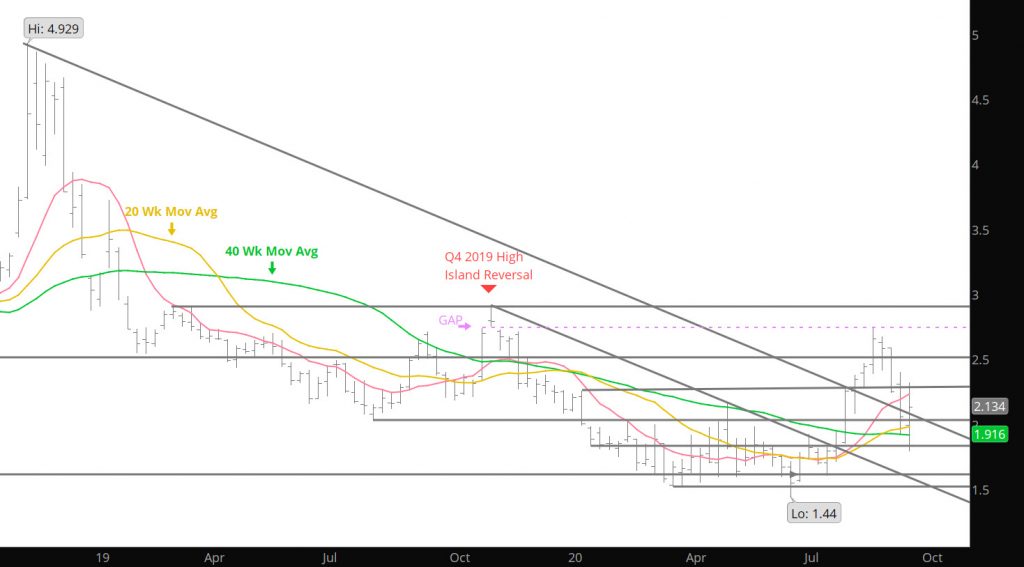
Weekly Continuation

A wild week for gas prices as prices started weak and tested the lows from late July, trading down to $1.795, then finding support and rallying prices back up to the initial support from the collapse the week before at $2.275. While prices pushed above that level briefly, they settled the week backing off.

While prices have had a wild ride with the October contract ($.53 range between high and low), the same cannot be said for the November contract ($.41 range). The premium afforded to November expanded and is approaching an extreme level.

To read The Daily Call you must be a subscriber (Current members sign in here. ) Start your subscription today.

Prices Return to the Mean
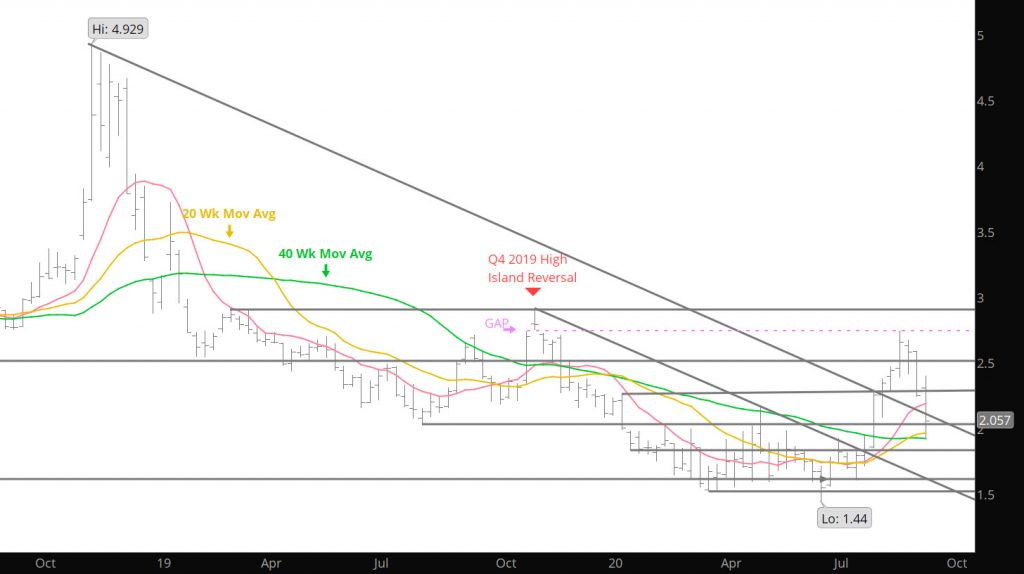
Weekly Continuation

Price action in commodities usually have a regression to the mean after spending an extended period of time at extremes. Trading greater than 2 standard deviations above the 20 week SMA for five consecutive weeks is trading at an extreme. While there was a relaxation of that extreme the week before last, the market was due for a regression at some juncture. Last week, the regression took prices back to the 200 day SMA, the 40 week and the 20 week SMA before finding support.

Monthly Continuation

Currently, the market remains within the extremes from the August price behavior. With all of the moving averages poised in a tight range (a nickel range) just below, an additional break down like last week seems unlikely.

To read The Daily Call you must be a subscriber (Current members sign in here. ) Start your subscription today.

Prices Retrace on Cue
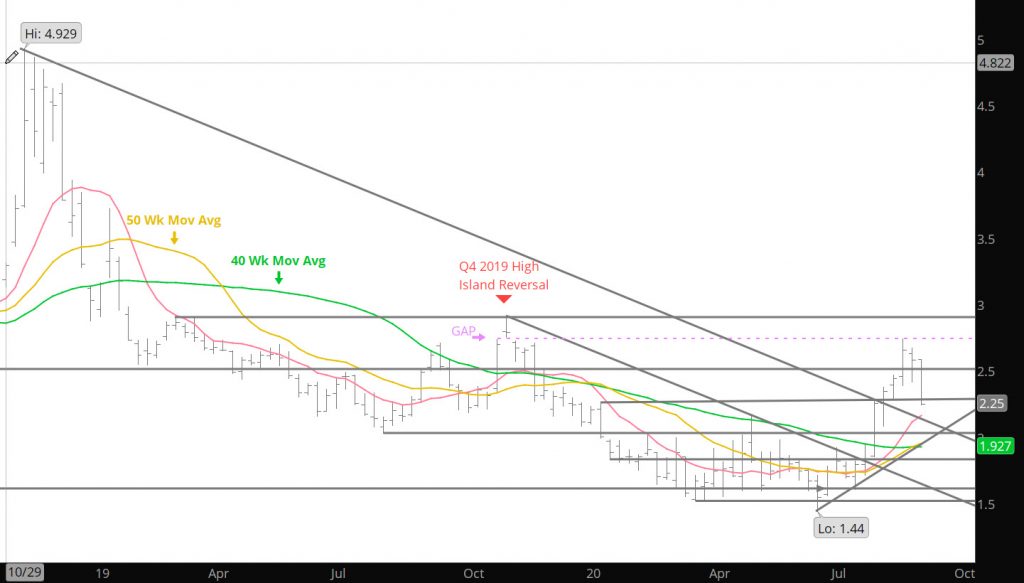
Weekly Continuation

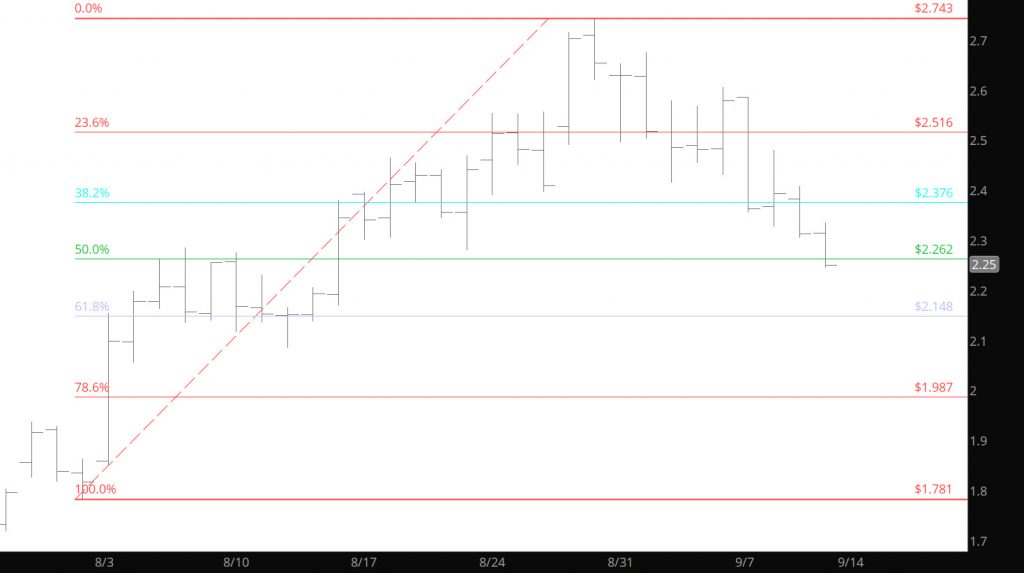
Suggesting for the last couple of weeks, that prices need to retrace the gains since the beginning of August. The last two weeks have eliminated the over bought status driven by the momentum indicators. The Fibonacci retracement went just down to the 50% support zone (from the lows in late July to the highs last week) see Chart below.

Fibonacci Analysis from late July Lows to Recent Highs

The declines are in-line with the the historical averages for declines from either side of the holiday. Now, the market will need to wade through the sentiment associated with the late year rally (occasionally concurrent with forecasts). Heard some whining during August, from many folks arguing against the well bid market when storage inventories are clearly going to be over 4 TCF. This is a fundamental concept that I ignore, but I remembered a few years ago when they ended over this level so I thought I would go back and look at what happened to prices. In 2016, prices rallied strong in October to correct some of the gains in early November then was well bid well into the winter. In 2015, after coming off declines most of the summer and fall— prices collapsed with a slight rally early in Dec. before resuming the declines, setting the stage for a multi-year low in March ’16. So there are two potential outcomes regardless of ending at 4 TCF, looking at history– yet another example of the value of technical analysis.

To read The Daily Call you must be a subscriber (Current members sign in here. ) Start your subscription today.

Looking At History
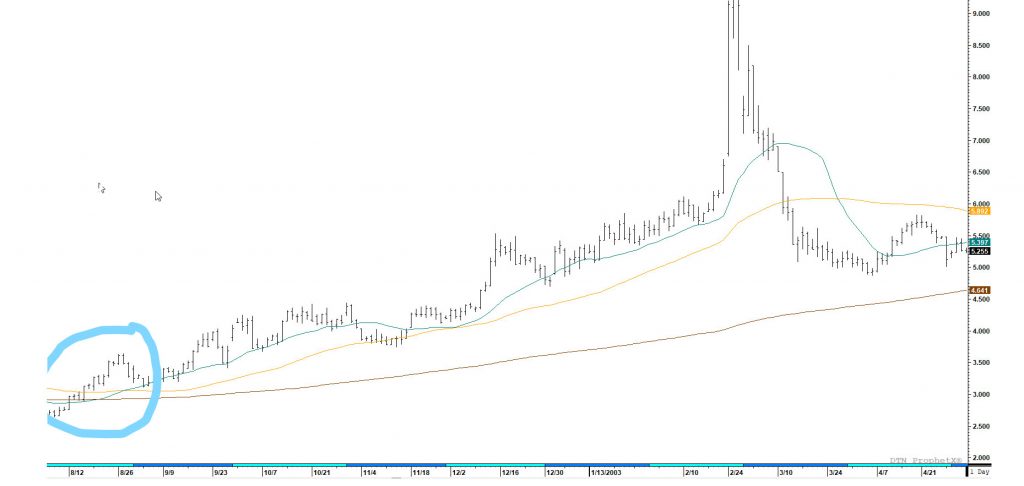
Daily Continuous from 2002/2003

Highlighted three years that prices stayed strong during August, but I wanted to focus on 2002, as the spread between October and November expanded to over $.40 in early September, which is similar to this year.
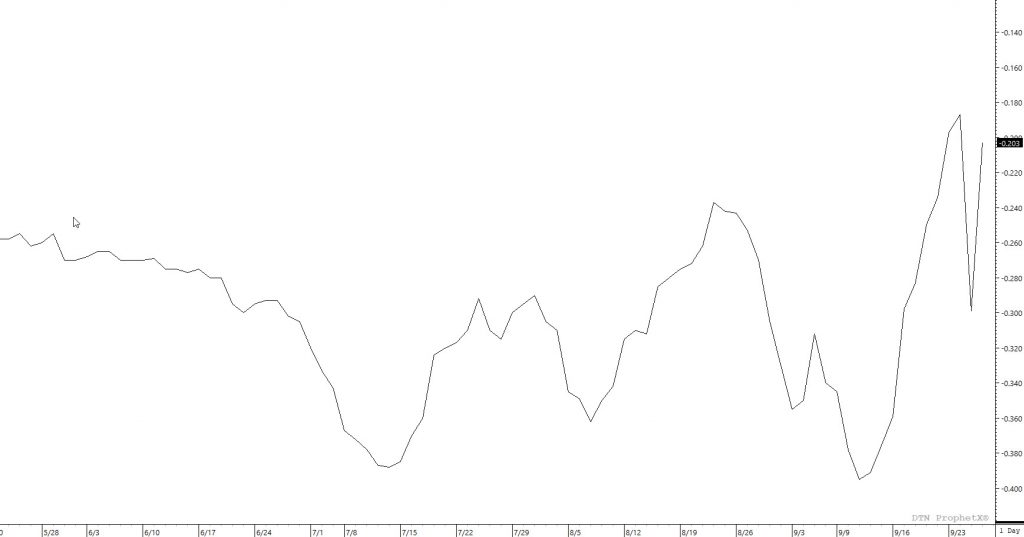
Spread Between the Oct and Nov Contract in 2002

Notice that the solid gains during the August month in 2002 (blue circle), prices then retracted 14.6%, before extending on a long term rally that didn’t conclude until February ’03. While that started, the spread between Oct and Nov contracts expanded to $.40 (premium Nov) during early Sept. Similar to the current year, prices held firm all during the August trade and currently trade $.45 differential to the November contract. The recent declines from the highs at $2.743 have corrected 14.7% at the lows yesterday. In 2002, the market did not correct until Feb 2003 as prices skyrocketed. Not sure if this occurs in 2020 but wanted to bring history to your attention.

Differed Contracts Remain Powerful
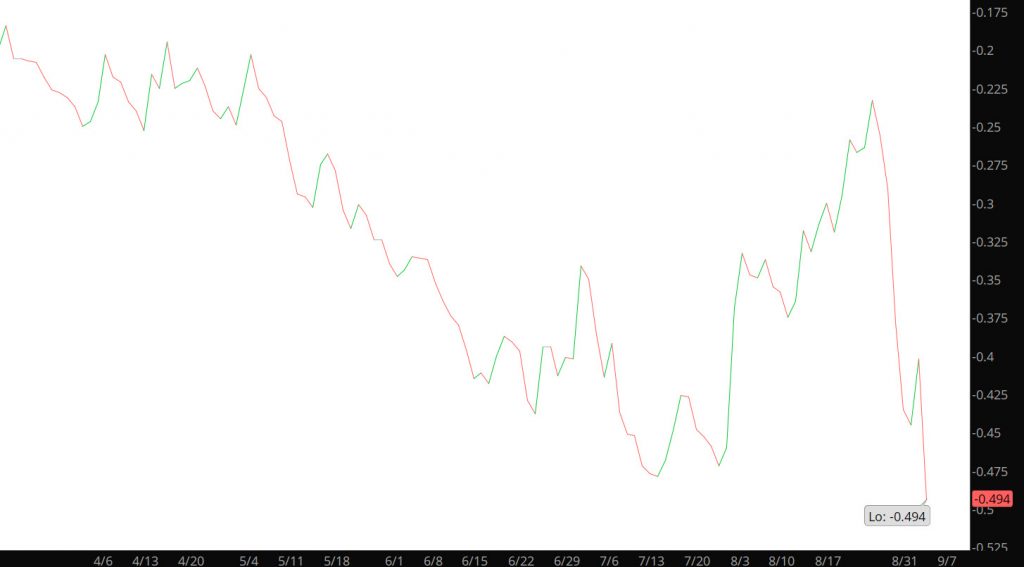
October less November Spread

Mentioned yesterday that some of the differed contract to the October contract were at substantial differences. Above is the October contract to the November, while it looked to be converging last week– yesterday’s action took it back to where the spread was at the beginning of Aug. It is clear that the market has some concern about the upcoming winter– regardless of the fundamental conditions. The gap between these two months (premium afforded to November) usually closes in early trade when Nov takes over as prompt. There is an exception to that expectation and will dive into that year later in the week. For now, focus on 2002, 2005 (do not weight 2005 as high due to the tropical influence) and 2013. Either the Nov contract has to come back to the Oct or the Oct has to chase Nov and diminish the premium.

I was expecting the Nov to decline in the seasonal weakness but it did not, in fact, expanded the premium. The market and prices are clearly indicating something but it is too early to tell. Be aware though of these premiums in your trading decisions.

To read The Daily Call you must be a subscriber (Current members sign in here. ) Start your subscription today.

Market Continues Consolidation
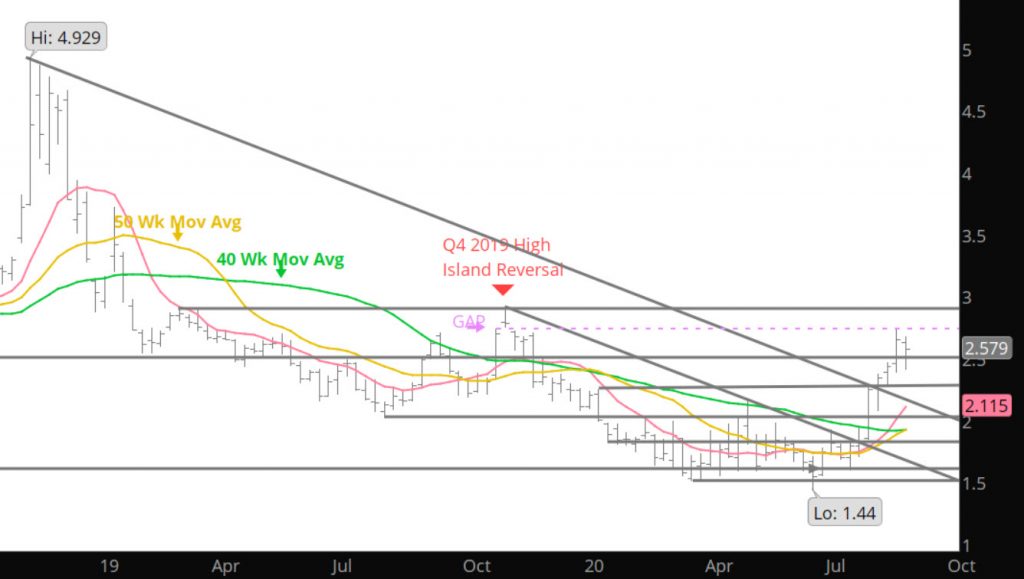
Weekly Continuous

Last week preformed what a consolidation market should– prices stayed in the recent range (inside to the previous week) with neither a lower low nor a higher high. That allowed some of the technical indicators to moderate as the Weekly RSI retraced from being in the extreme over-bought area, but remains in the over-bought zone. The Bollinger Band study has prices just at the 2 standard deviations above the 20 week SMA, which is starting to correct from it’s recent extreme level of nearly 3 standard deviations over the SMA.

This price behavior and movement is consistent with recent run during August and now it will be important to identify the support zone that the market should establish, likely from the historical weakness in prices during the Labor Day time period.

To read The Daily Call you must be a subscriber (Current members sign in here. ) Start your subscription today.