Another Lower Weekly Trade

Weekly Continuation

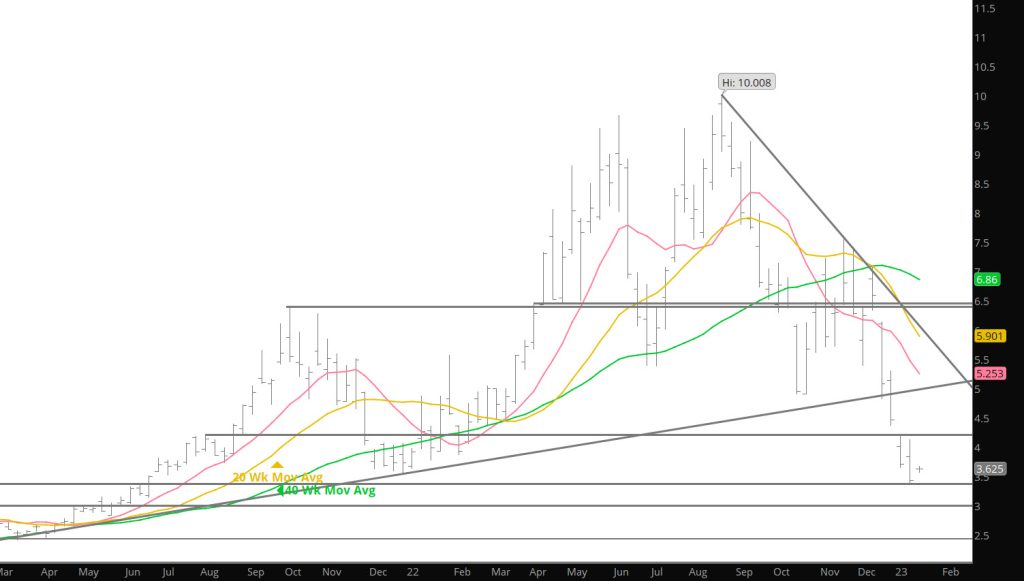
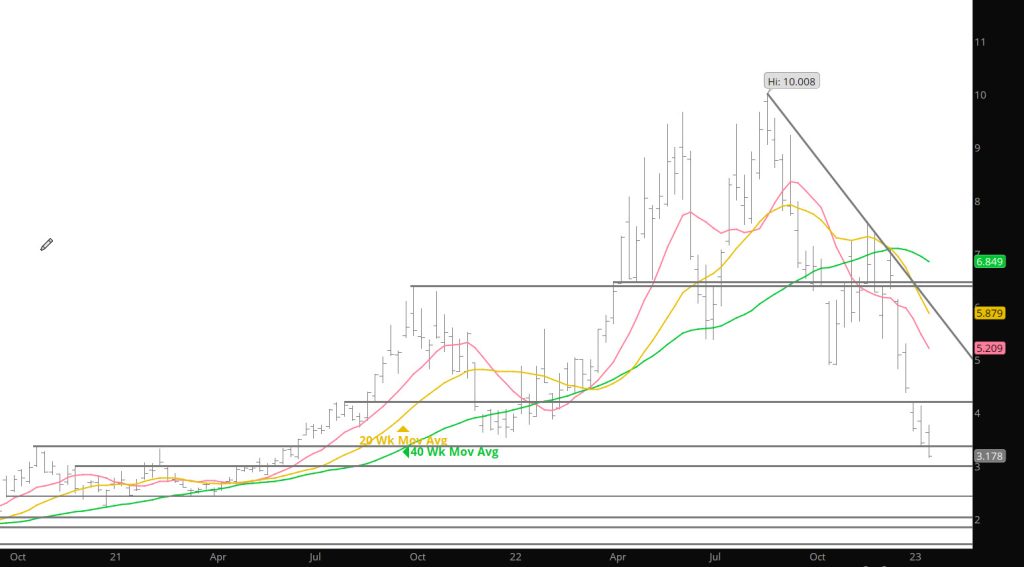
Prompt gas closed lower for the sixth straight week (each week since the peak of the seasonal rally to a mid – December high – a one week uptick following a two week decline from the November high). Over those weeks, on a closing basis, prompt January and then February have fallen from$7.024 to $3.174. That kind of decline is not unprecedented, but it is rare and it has been a long time since last occurring.

There are other mathematical indicators that are used to monitor the overbought/oversold condition of the market, one such tool looks at the percentage the market trades as compared to the 40 week Simple Moving average. At Friday’s close prompt gas was 53.7% below the now declining intermediate – long defining moving average. You may recall at the high weekly close during August prompt gas was 54.5% above the 40 – week. Over the history of natural gas trading there has only been one other comparable rally and decline that carried to similar extremes.

To read The Daily Call you must be a subscriber (Current members sign in here. ) Start your subscription today.

Holiday Prices Bounce Off Support

Weekly Continuation

The current natural gas market is dissimilar to last year (from a technical standpoint) as prices are now developing over-sold conditions from declines that commenced last September.  As the weekly chart (with Bollinger Bands) shows below, the market is now trading at 2 standard deviations below its 20 week moving average (last week’s close) —a level that historically does not maintain the market for very long and usually presages a rally or series of rallies.
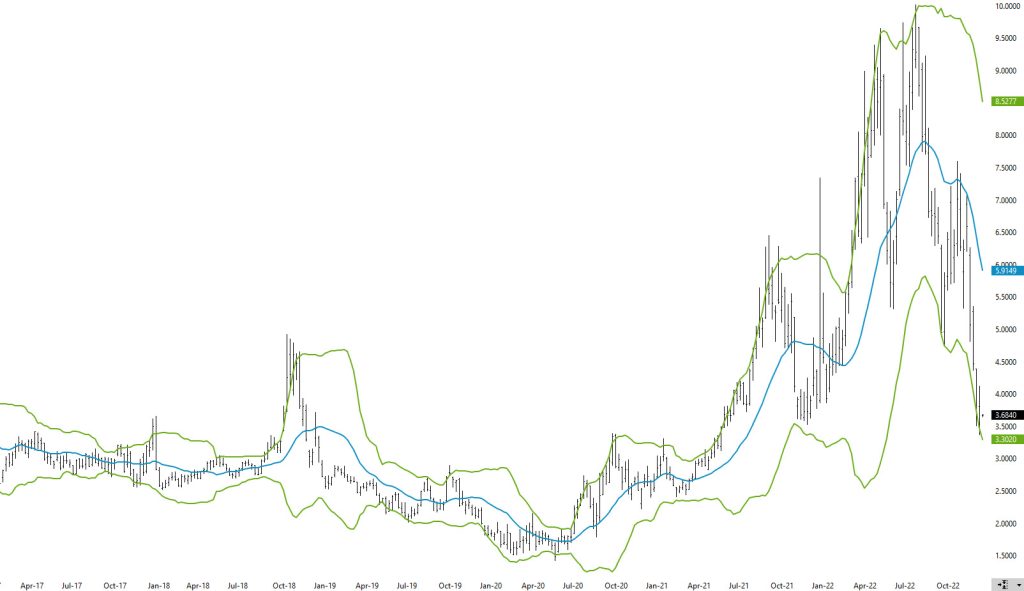
Weekly Continuation with 2 Standard Deviation Bollinger Band

It is also concerning, that the declines of late have caught the interests of the speculators.  The latest Commitment of Traders Report has the Managed Money Short positions increasing their short commitments with the expectations of further declines.
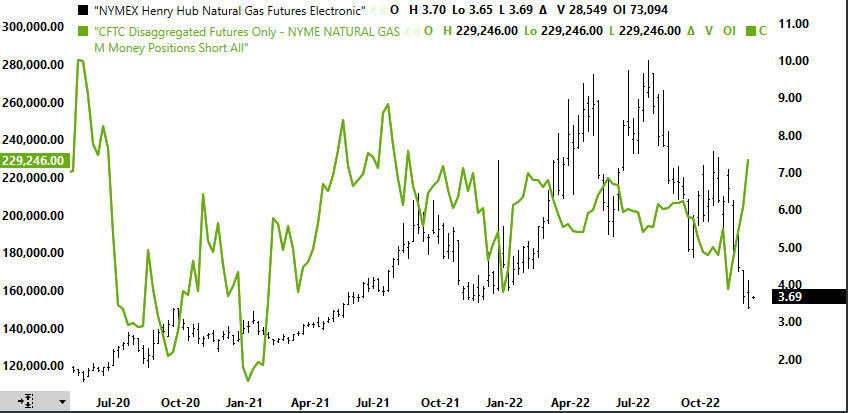
Weekly Continuation with Managed Money Short Positions

The increased attention from the speculators to the price action suggests that there will likely be upcoming volatility in the market.  When this group comes into a market aggressively—it sets the market up for violent short covering rallies when the prices find support. Exposure to these rallies should be minimized by a hedging strategy.

Expect rallies off of support and should these rallies break some key resistance areas — forcing the shorts to cover some positions– the rally may become violent.

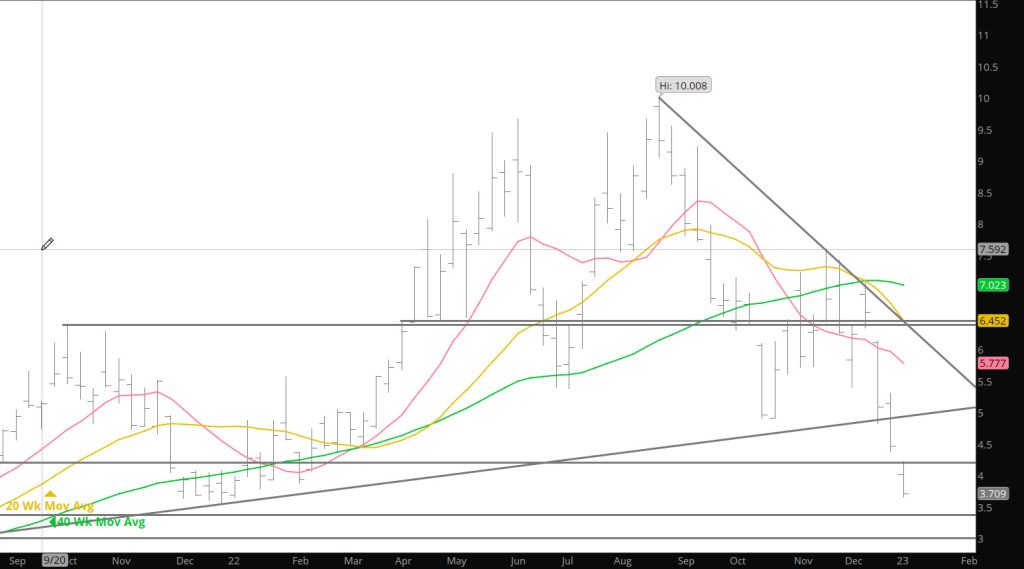
Major Support: $3.638-$3.536
Minor Support:
Major Resistance$4.22-$4.39, $4.75-$4.825, $4.948, $5.056

Bull Run (Two Year+) Ends
Weekly Continuation
Monthly Continuation

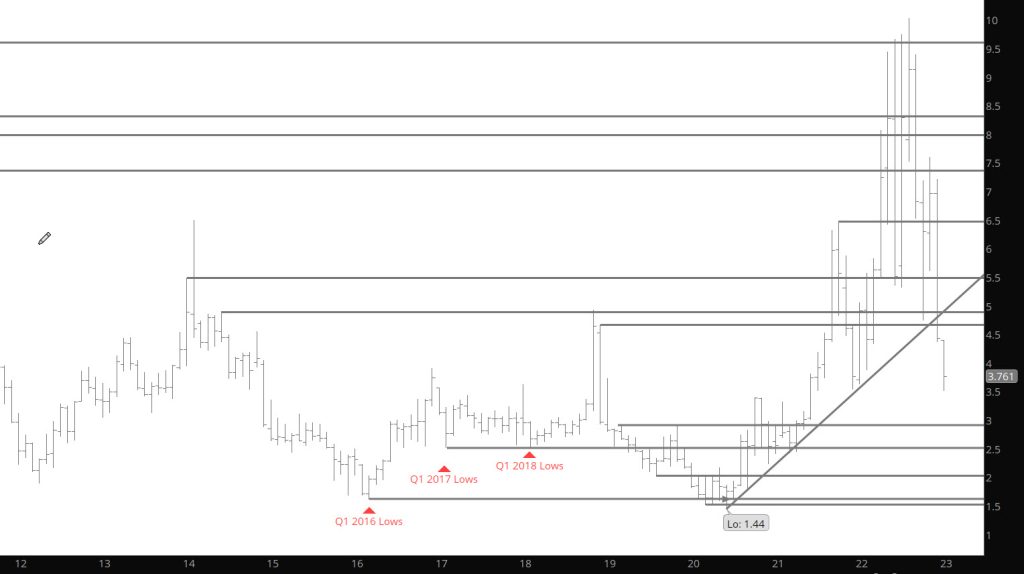
The uptrend that first began following the June ’20 low, was conclusively ended when the calendar December close for prompt gas was below the trend line drawn from that multi – year low and the December ’21 low (See Monthly Continuation chart above). That does not mean that the gas market is headed to zero or even back to test the last multi – year low, but the downside momentum that began to be generated by the bearish momentum divergences that accompanied the August high is likely to take some time to be completely neutralized. While it may not seem so, price volatility has actually decreased…the weekly ATR (the average range of the last fifteen weeks) has fallen from $1.413 on 07/29 to $1.091, over the last few weeks from $1.155. This week’s range was $.874 the narrowest since mid – November.

That said, a volatile rally is overdue. Over the last four weeks since the seasonal early – mid December high on 12/13, prompt gas has fallen from $7.105 to $3.520 (over 50%). In the process the gas market has finally reached an extremely oversold technical level. The weekly RSI ended the week at 24.29 that has the “leading” indicator, lower than that for one week during October, which was followed by a weekly reversal and a rally from $4.750 to $7.604.

To read The Daily Call you must be a subscriber (Current members sign in here. ) Start your subscription today.

Declines Break Testing Two Year Support
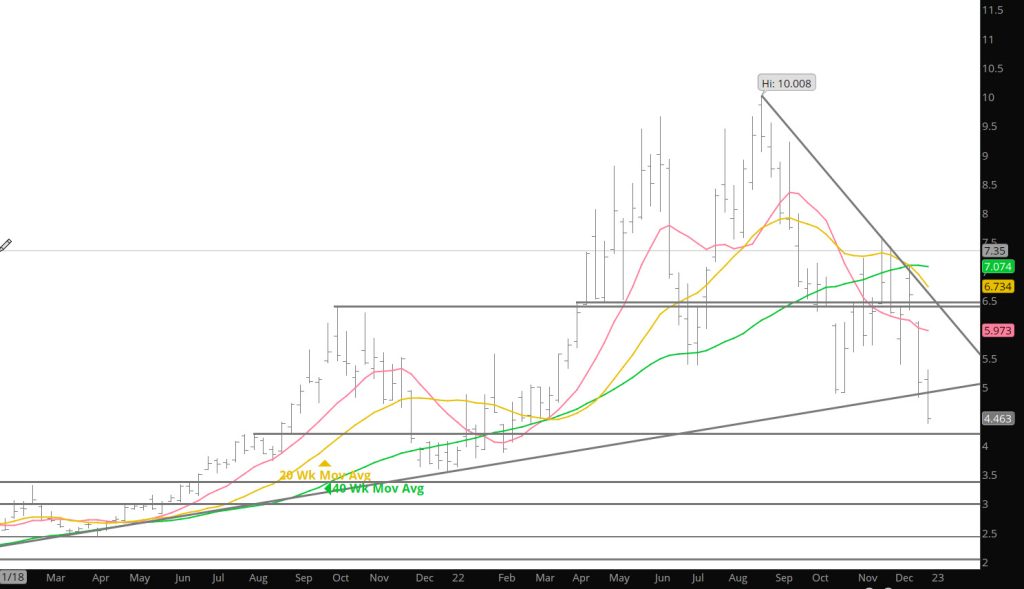
The warming weather trends last week took prices down to test levels of support that have not occurred since a year ago. As discussed last week the market has a tendency to develop a key level around the 1st of January.

…late December/early January highs or lows have consistently been disproportionately important going forward into each new year.

To read The Daily Call you must be a subscriber (Current members sign in here. ) Start your subscription today.

Big Gap Open Only to Fail
Weekly Continuous

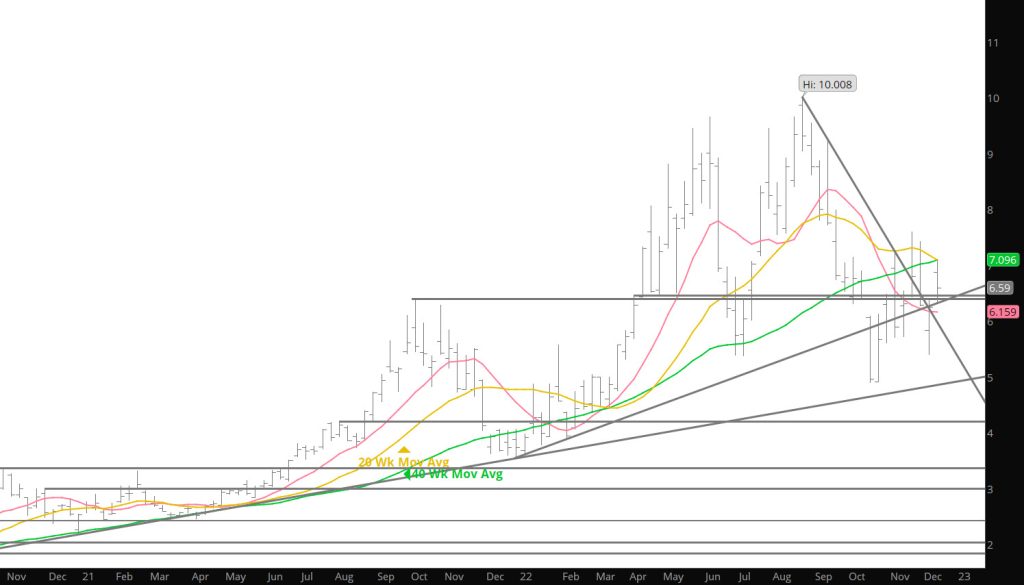
Follow through buying took the prompt to $7.058 before a reversal lower. Another one on Tuesday in the opposite direction set the week’s high at $7.105 testing the resistance from the intersection of the 20 – week SMA and the still rising 40 – week SMA. From those levels, prices immediately retraced and closed the gap from Monday and closed the week in the middle of the range.

The results left prompt January $.355 higher, but examination of individual monthly gains in the winter prices, showed an interesting divergence. Weekly gains of February were over $.20 except for March. Sandwiched between February’s + $.221 and April’s +$.229 was March at +$.037. Chances are (guesses really) are that difference was a result of substantial buying of January and February while simultaneously selling March– sometimes referred to as a near – term bull spread. Building length in the remaining winter while offsetting that length in March. With strong volume in that spreading would indicate that folks are expecting additional winter strength in early 2023.

To read The Daily Call you must be a subscriber (Current members sign in here. ) Start your subscription today.

After Gap Down, Prices Recover During Week
Weekly Continuation

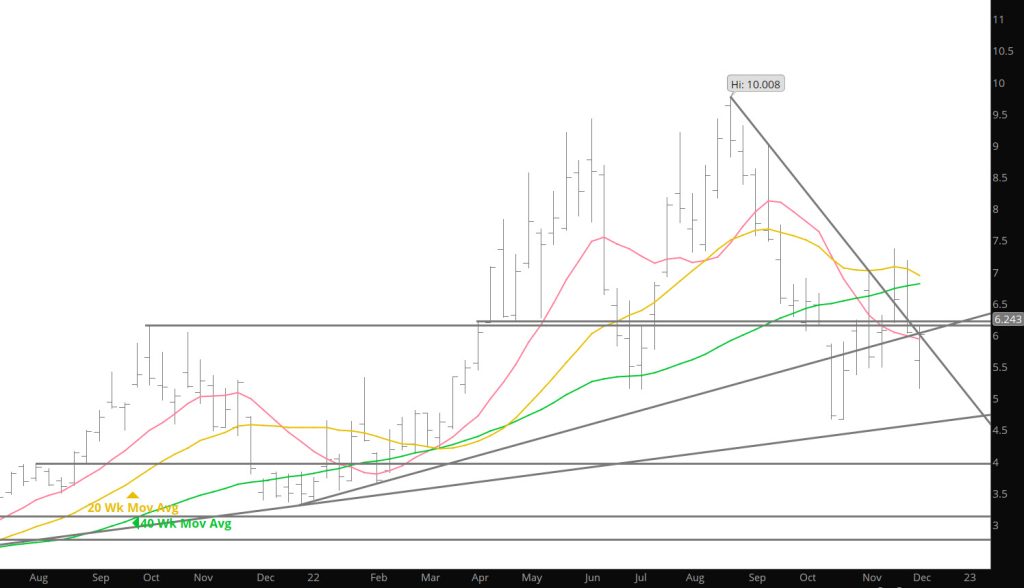
January opened with a gap sharply lower from the previous week’s close at $6.281 to $5.900, through support defined by a series of lows traded by January gas between 11/09 and 11/16 ($6.131 – $6.260) and January’s November low ($6.011). The downside momentum generated by the exceptional gap triggered a substantial volume increase and a near immediate test of the continuation November low ($5.614 corresponding to January’s October low, $5.645). On a daily closing basis, prompt gas held the November low on Monday ($5.624 vs $5.614) but trade suggested that those lows were vulnerable to test the June/July lows $5.325 – $5.357. Last week’s low was $5.337.

Prompt January held the support and reversed higher but the odds of closing the weekly continuation gap left on Monday, which remained open between $6.052 and$6.221 were so remote the potential was not even mentioned in the Daily. Sure enough, it was and then some. In a year of improbable occurrences (the first ever annual high during calendar August, so far, for example) January rallying $1.054 after a high – volume gap down followed by the test of lows traded during the summer was one of the more near – term remote probabilities.

To read The Daily Call you must be a subscriber (Current members sign in here. ) Start your subscription today.

Bias Switch
Weekly Continuous

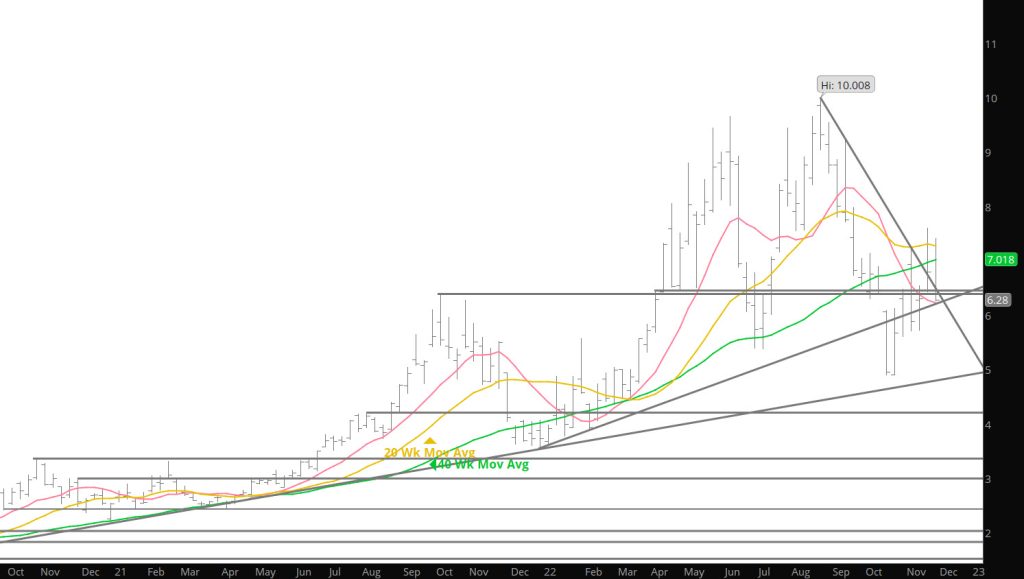
The break down of the trend line (mentioned on Friday) was a clear signal that prices were headed lower. That is why some of these technical levels are so important– they signal break down’s or break out’s. From there the question remained would the break out area around $6.45 hold which it did momentarily before capitulating, opening the door for prices to collapse another $.20. It is clear that the historical trend of weaker prices into early December remains well in place. The consensus of technical indicators had made steady, incremental progress since late October, gave up most of that improvement and retreated to neutral with a price negative bias.

Market internals were mixed during the past week but not nearly as weak as one might be expect given January’s reversal lower, average daily volume was much less than during Thanksgiving week by an estimated 90,000 contacts. Volume is supposed to expand if a substantial price move is sustainable.

To read The Daily Call you must be a subscriber (Current members sign in here. ) Start your subscription today.

Break Out Through Resistance
Weekly Continuous

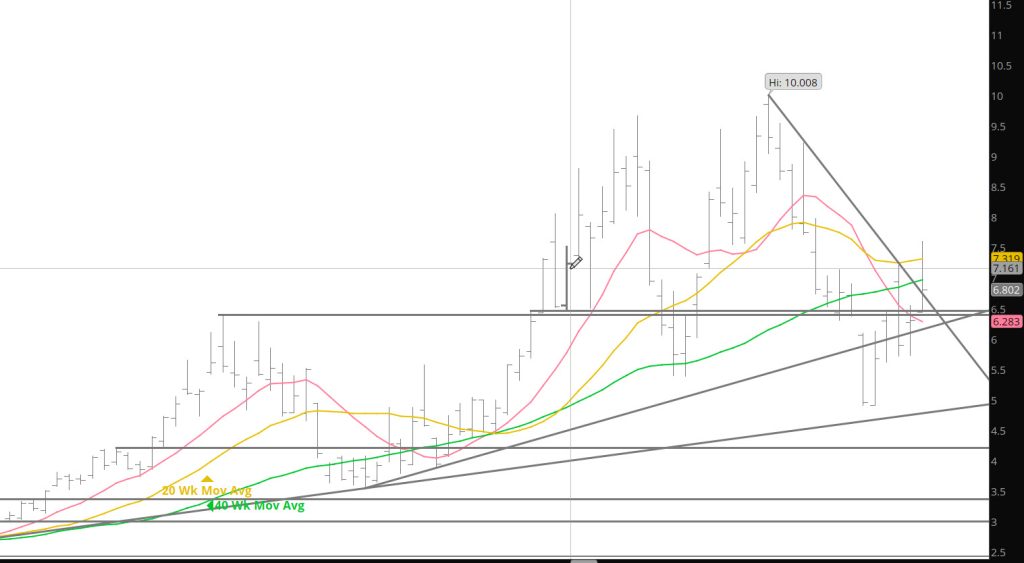
As mentioned in the earlier Daily and Weekly writings, the area around $6.45 was key and the action last week confirmed as a rally broke above and sent the soon to expire over $7.00 quickly. Due to the light holiday related trade and the fact that the virus has returned to my chest — I will keep today’s Weekly Comments short. This last week’s exceptional counter seasonal price strength managed to pull the remainder of the winter strip back to and just above its still rising 40 – week SMA. Mentioned “counter” because there is historical evidence that the period around the Thanksgiving holiday is weaker (usually after trading to a pre-holiday high). Perhaps this year will resemble the historical norms with prices weaker during this week’s trade.

The technical indicators…which is heavily weighted to prompt gas, moderated last week and showed improvement this last week. The volume traded during three- and one-half trading days was nearly as high as five trading days last week…average daily volume increasing an estimated 95,000 contracts as prompt gas rallied to and through moving average, conventional and trend line resistance. Open interest declined modestly, suggesting that short covering played only a minor role in the rally—or that new buying was sufficient to offset what was likely a more significant amount of buying to cover contracts previously sold short.

To read The Daily Call you must be a subscriber (Current members sign in here. ) Start your subscription today.

Consolidating For a Run or Break Lower
Weekly Continuation

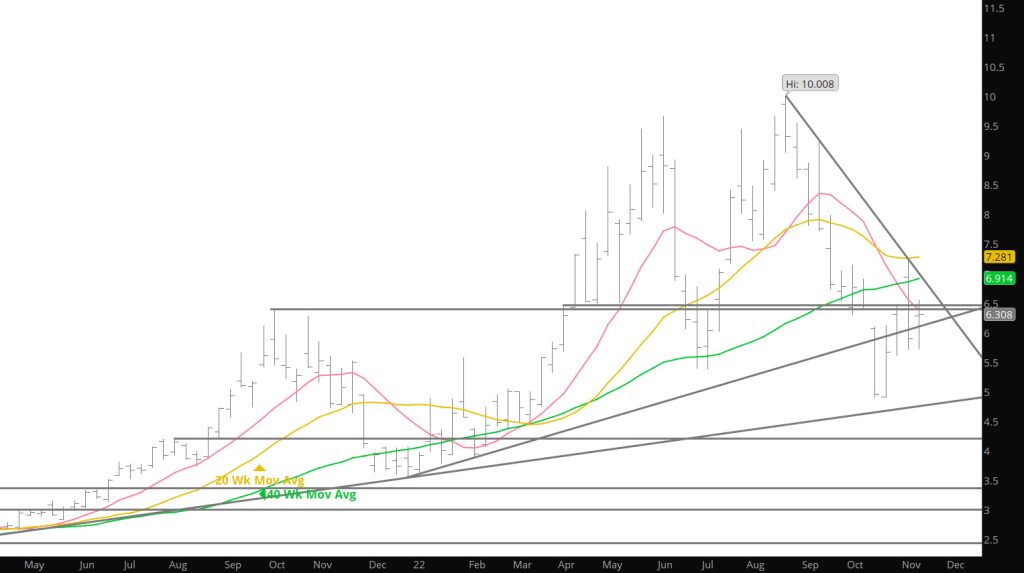
After a “somewhat” calm wee of trade the question that was mentioned in the Daily –Is gas constructing a base to resume the secular uptrend higher or is it consolidating after a substantial decline during the nine weeks between the August high and the October low, thereby allowing the extremely oversold conditions to moderate, before another “leg” lower. Both directional bias’ seem to have significant contingencies which means that violent whip saw action may occur.

For the market to advance after building this base, a violation of the intermediate downtrend line will suggest that the decline from the August high ($10.028 – $4.750, 52.6%) has likely concluded, but not necessarily that a serious rally will follow. Higher levels of resistance, not limited to the the November reversal high and the still rising 40 – week SMA, are formidable areas. Three of four higher weekly closes suggest that December is gaining the sponsorship for a successful test of the declining resistance. Violation of the trend line and a weekly close above $6.459 will suggest that prompt gas has traded the first higher close of a new intermediate term uptrend (as discussed in the Daily).

To read The Daily Call you must be a subscriber (Current members sign in here. ) Start your subscription today.

Reversal Week
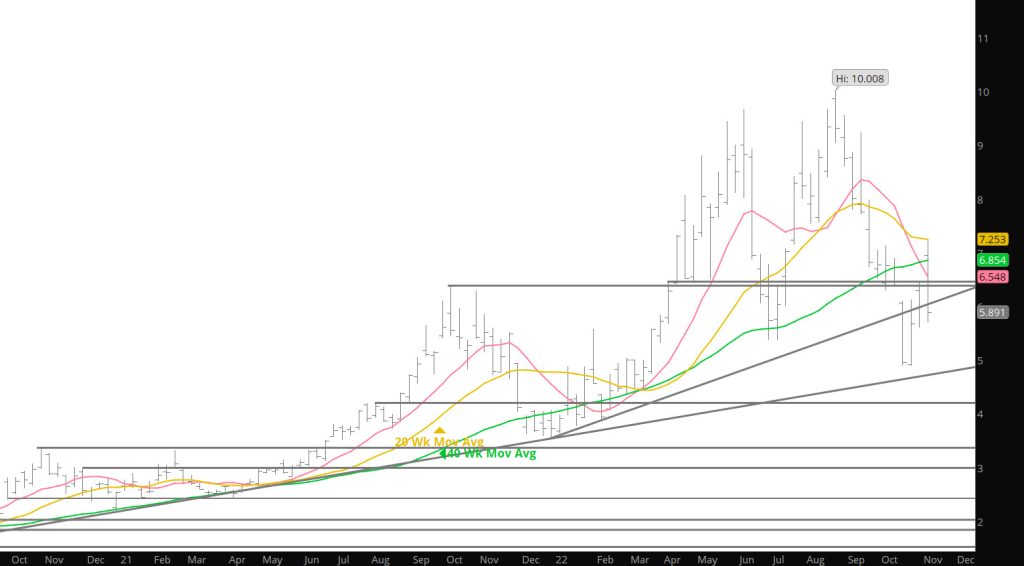
Weekly Continuous

I have no clue what stimulated the market to the opening gap of that size (last Monday) but it took the prompt through the still rising 200 – day SMA. The run did not last long as December quickly fell to close the gap and continued lower. After back – to – back weekly gains, the first since the final run to the August highs, on Friday a failed recovery attempt, terminated ending up as a downside reversal from just above the previous week’s high to close the reversal lower. The week ending daily reversal left December back below $6 (where most of the trade during it’s tenure as prompt has been spent). Critical support for December is between there and its October and to date November lows ($5.345 –$5.614). Events like this week’s reversal following an opening gap and then the moving average cross along with other factors suggest that rallies in December gas will be enthusiastically sold.

The last time the continuation 10 – week (SMA) crossed through the 40 – week was during January AFTER the construction of the December ’21 low and remember moving averages are always “lagging” indicators. The 10 – week remained there for several weeks until prompt gas kicked off on the late winter/early spring rally.

To read The Daily Call you must be a subscriber (Current members sign in here. ) Start your subscription today.