Declines Occur With Lower Volume

Weekly Continuous

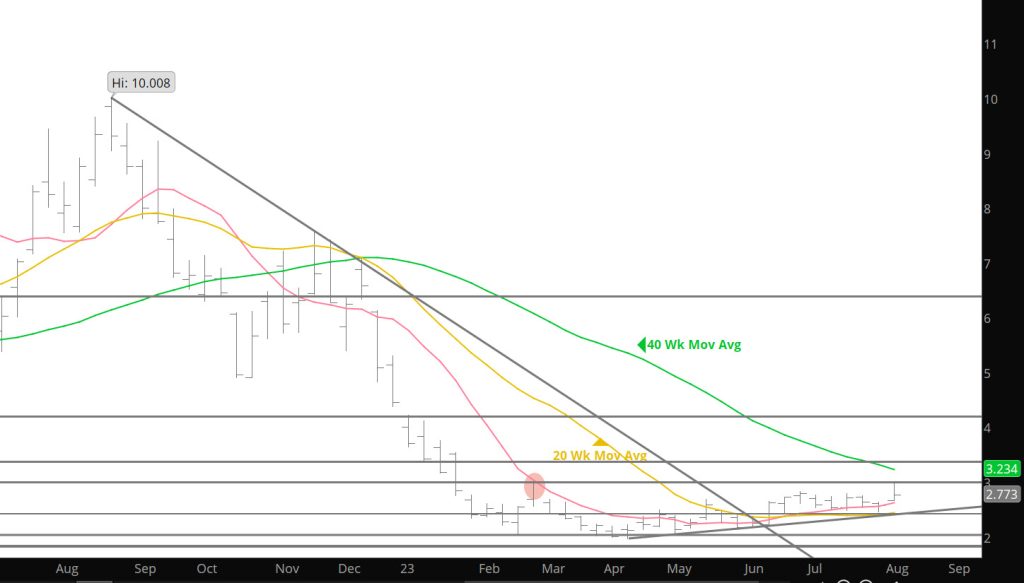
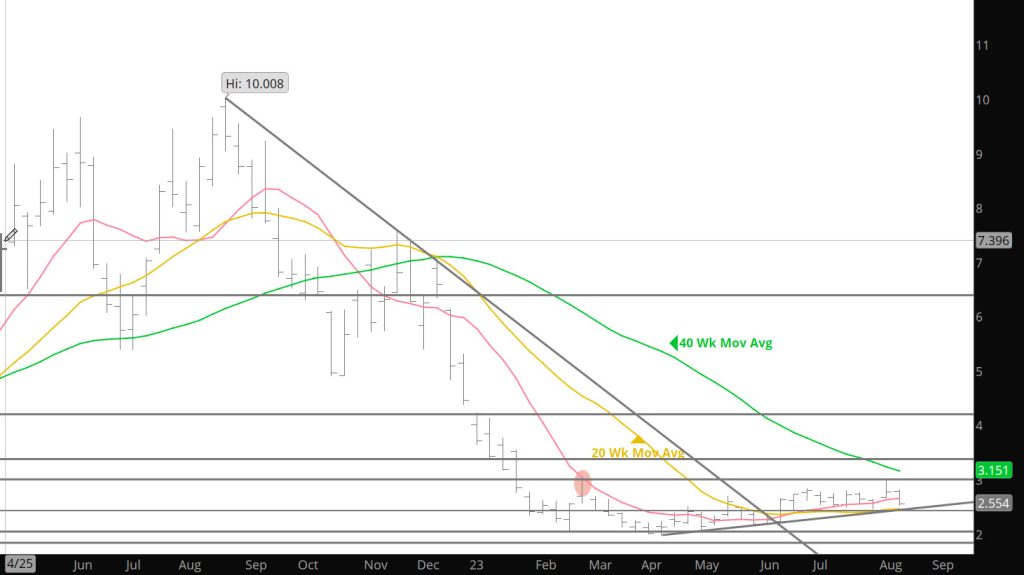
After trading just briefly back above the June high ($2.839, the previous week’s high was $2.863) September gas reversed lower, again failing to close above the zone of resistance between the June and July highs with an increase in open interest. That failure brought a decline further than anticipated but with a substantial decrease in volume. The target suggested last week was $2.60ish but that zone of defined support did not limit September’s fall as the prompt traded to a low of $2.524 before recovering to close at $2.551. Notably, the close was well above the cluster of weekly lows that traded between the end of June and the beginning of August (+/- $2.45 –$2.49) but also below last week’s low. A lower close below the previous week’s low infers additional weakness coming.

Despite modest price erosion of near term gas over the last two weeks, September closed $.026 lower than two weeks ago, but the strips are higher with winter $.136 over the last ten trading days, one – year $.092 higher. Perhaps that’s how the Q3 seasonal pressure plays out this year. The strips are much closer to earlier highs. Prompt gas traded that Q2 high on 06/28, the high daily close of the winter ’23 – ’24 was $3.613, Friday’s close was $3.612. The high daily close of the continuation one – year during the closing days of June was $3.363, Friday’s close $3.307. Maybe my analysis is way off base but seems to me those differences suggest that sponsorship is building for deferred/distant deferred contract months.

To read The Daily Call you must be a subscriber (Current members sign in here. ) Start your subscription today.

A Defining Week

Weekly Continuation

The market has prompt gas construct and remain confined within a tight trading range about a third as wide as the range constructed between the range traded during calendar March for a while. The expectations were that prompt September would remain within that range for the duration of its tenure. Then there were four straight weekly lows between$2.457 and $2.492 (and others in the neighborhood), and the tendency of September gas to trade the low of its tenure in early August, fed the bias is that prompt gas is winding up for a run later into the quarter. Well I did not see was the likelihood of a short covering event the likes of which I can’t recently recall.

Open interest (the total of contracts open in the market) has been falling since a peak of 1,389,864 on June 6th (4 days after the June low at $2.136). As written here many times, when open interest falls while price increases the presumption is that participants buying contracts to offset those previously sold short is a significant contributor to an increasing bid. Since that June low prompt gas had traded as high as $2.839 (the June Q2 high) as the liquidation of open interest remained a more or less orderly process while the weekly closing trading range between +/- $2.47 and $2.80 was constructed. That ended this past week.

To read The Daily Call you must be a subscriber (Current members sign in here. ) Start your subscription today.

Near Term Support Holds
Weekly Continuous

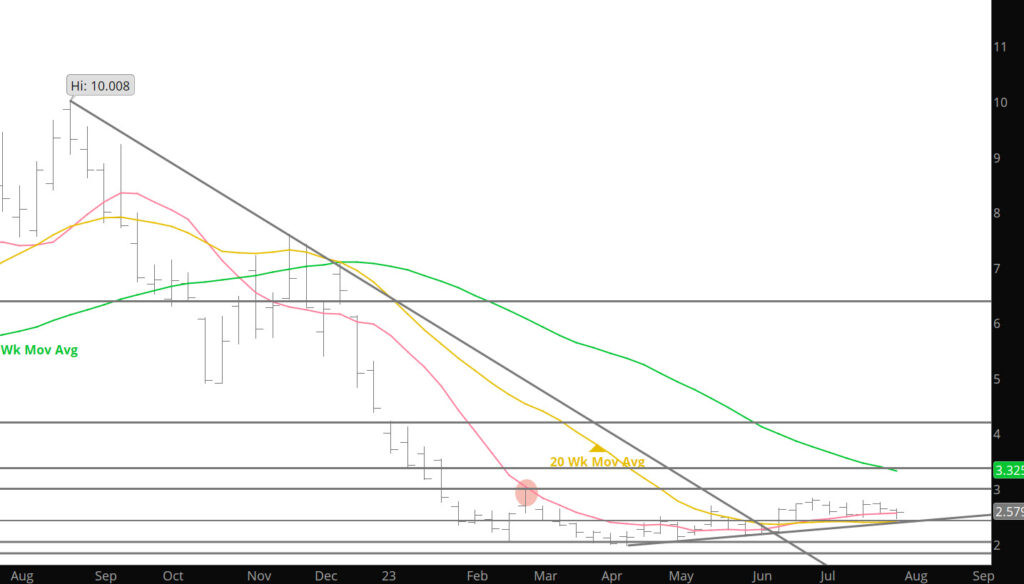
Last Week’s low broke slightly lower than expiration week, as September did trade a lower low ($2.457 vs $2.463 previous week. That extends the seasonal Q3 decline to 13.5% from the June Q2 high ( less than half of the ten year average for the decline) and goes into the books as a violation of the July low for the fourth straight year. The absence of any follow through after trading a lower low says something about the support that we have talked about for the last several weeks. Prompt gas hasn’t traded an “outside” August (trade through both the July low and high) since 2010 but back then it use to do it on a regular basis (’10, ’09, ’07, ’02 and ’01). Given the “recent” history trading through $2.793 (the July high) seems like a low probability event.

For the fourth straight week support above $2.450 limited any further decline. The last lower low was $2.448 on June 21st. The prompt did start out a little stronger (trading to a high of 2.693) after settling the previous week at $2.638 but quickly failed. For eight straight trading days prompt gas failed within the range of the last high volume day (July 20th) when a few more than 500,000 contracts traded. The high that day was $2.789. Trading highs within the range of a high volume day is characteristic of the continuing consolidation and construction of a trading range. The zone between the July high and the June high, $2.839, forms the upper boundary the recent range.

To read The Daily Call you must be a subscriber (Current members sign in here. ) Start your subscription today.

Recent– Higher Settlement’s Trend Ends
Weekly Continuous

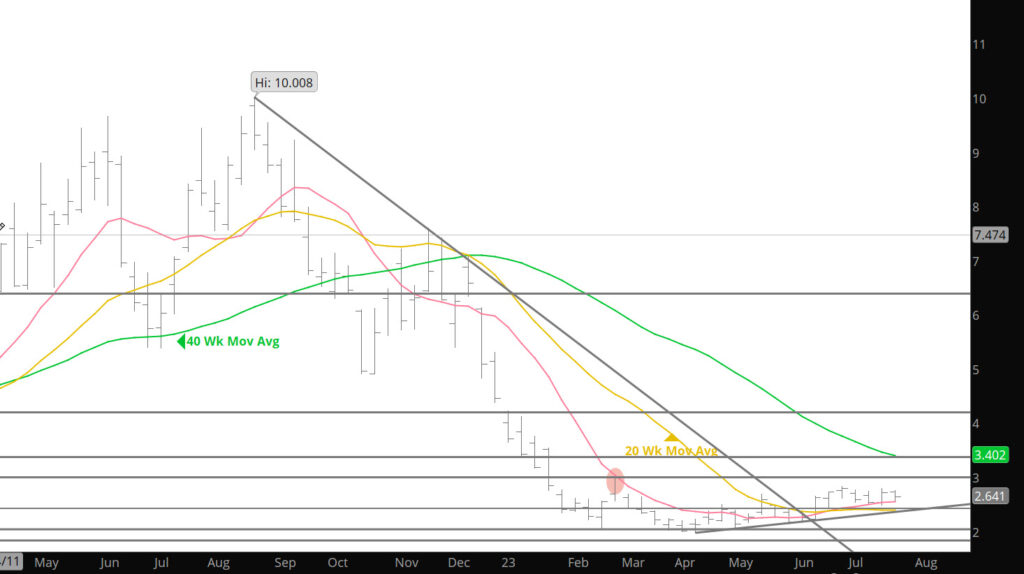
After trading another weekly high, failing at the band of resistance discussed last week, there have now been four straight weekly highs between $2.750 and $2.793, six between $2.740 and $2.839. There is clearly technical resistance in this zone and seldom as clearly defined as that. August went from premium to September in a hurry as it quickly made its way to support, also is just about as clearly defined. The lows of the last three weeks have been $2.492, $2.484 and $2.463. August went off the board exactly equal to the low two weeks ago and a little above the others ($2.492, $.111 under July and the first lower contract expiration since April settled at $1.991). discussed previously, the August contract has been described as historically amply offered. Given the way it went to expiration that again appeared to be the case. The low of its tenure as prompt printed shortly before trading in the contract ceased. Absent a high volume breakout through the resistance described above, September is likely to be subject to the same price negative Q3 seasonal pressures as its predecessor.

Long time readers know that I utilize and trust historical trends and almost always write about seasonal pressures during the summer. The weak close of August gas notwithstanding there really hasn’t been a lot of evidence of that seasonal pressure during the summer of ’23. From the 06/28 Q2 high to Thursday’s expiration July low prompt gas fell $.376 or 13% vs a ten year average decline of 27%. There is a long time left in the calendar quarter, but the historical fact is that September gas tends to trade the low for its tenure as prompt in early August. Over the last seven years (since 2016) that low has traded between the first and sixth trading days of the month five times (’17, ’18, ’19, ’20 and ’22), on the tenth trading day once (’16) and on the fourteenth once (’21). September contracts have settled from $.073 (’18) to $.725 (’20) higher than August in all but one of those years (-$ .008 in ’17). The takeaway from that is that while it has not always been so, in recent years seasonal pressure has been more likely to be in evidence in July and September.

To read The Daily Call you must be a subscriber (Current members sign in here. ) Start your subscription today.

Back In the Saddle
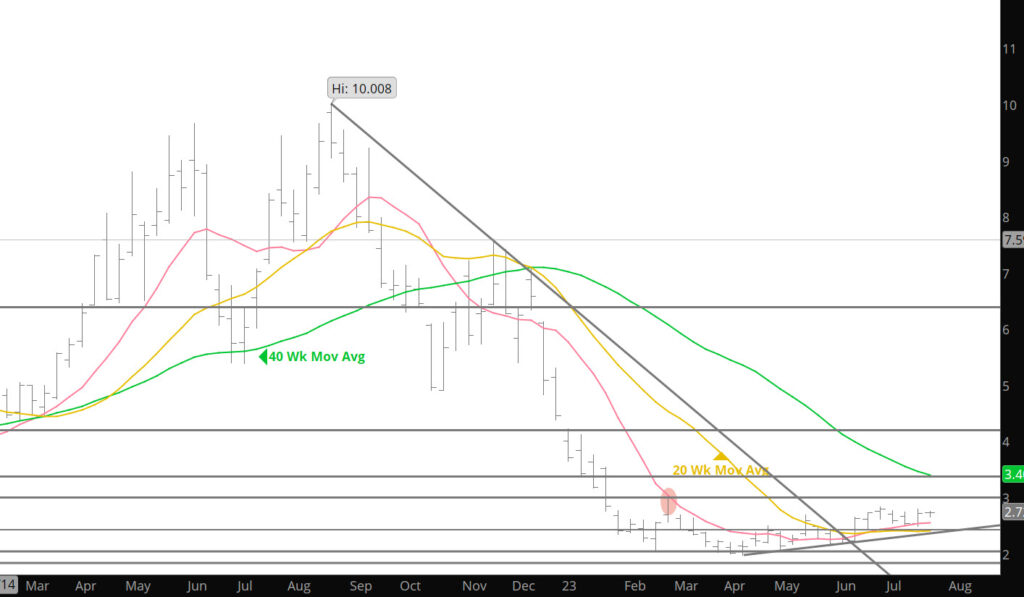
Weekly Continuation

Did not send out a Weekly analysis on Sunday so I wanted to share comments from the weekend charts (even though they are current for this week). In last week’s items there was a discussion of a very significant zone of support between +/- $2.330 and $2.450. Analysis strongly suggested that August gas would be “drawn” into that zone before rallying. When trading resumed, August was offered below lthe previous week’s low and expecting that the triggers for additional selling within that zone would be hit. It did not happen. Following a low print of $2.484 August reversed course and ultimate traded through last week’s high (forming an “outside” week reversal higher) and did that with increasing volume. Perennially amply offered August (although it certainly wasn’t last year) closed higher for the first time in four weeks. Prompt August has redefined support with back to back weekly lows of $2.484 and $2.492 ( four of the last five weeks between $2.448 and $2.536; resistance with consecutive weekly highs of $2.793, $2.750 and $2.789–with four of the last five weeks between $2.740 and $2.83.

To read The Daily Call you must be a subscriber (Current members sign in here. ) Start your subscription today.

July Seasonal (post 4th) Declines On Time
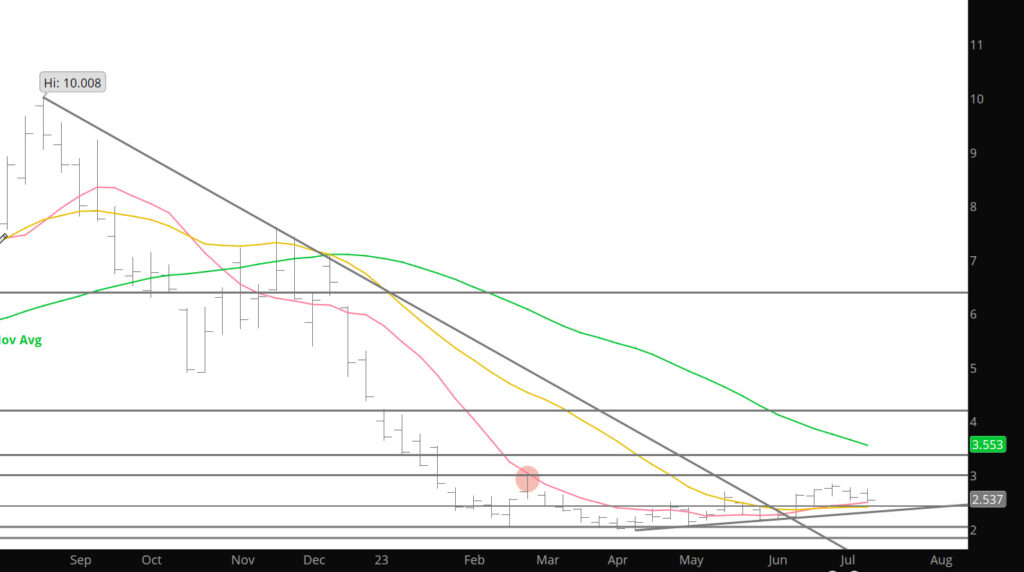
Weekly Continuation

The two day rally failed at the start of the week fell a little short of last week’s high ($2.750 v $2.793), which was lower than the previous week’s high and the rally gains were quickly forfeited. With volume increasing the prompt tested last week’s low but held just above $2.536 ($2.539)…lower trade for a third straight day validated last week’s ideas of lower trade as the post – Independence Day decline was extended to $2.492.

The historically consistent seasonal decline from a late June high (measuring from the 06/20 recovery high of new prompt August), was extended to $.336 or just about 12%. That is a little more than the three and five years average declines, a little less than the average of the last ten years. While the memory of last year’s rocket ride from the post – Independence Day low (from an 07/05 low of $5.325 August ’22 rallied to a 07/26 high of $9.752) is still fresh, the recent price action is more typical of July trade. Declines should be extended a little further before sufficient sponsorship is uncovered to lift August to a somewhat higher expiration. History suggests that over the years August has settled lower than July far more often than not, but August has been higher in each of the last three.

To read The Daily Call you must be a subscriber (Current members sign in here. ) Start your subscription today.

Prices Test Low End of Support
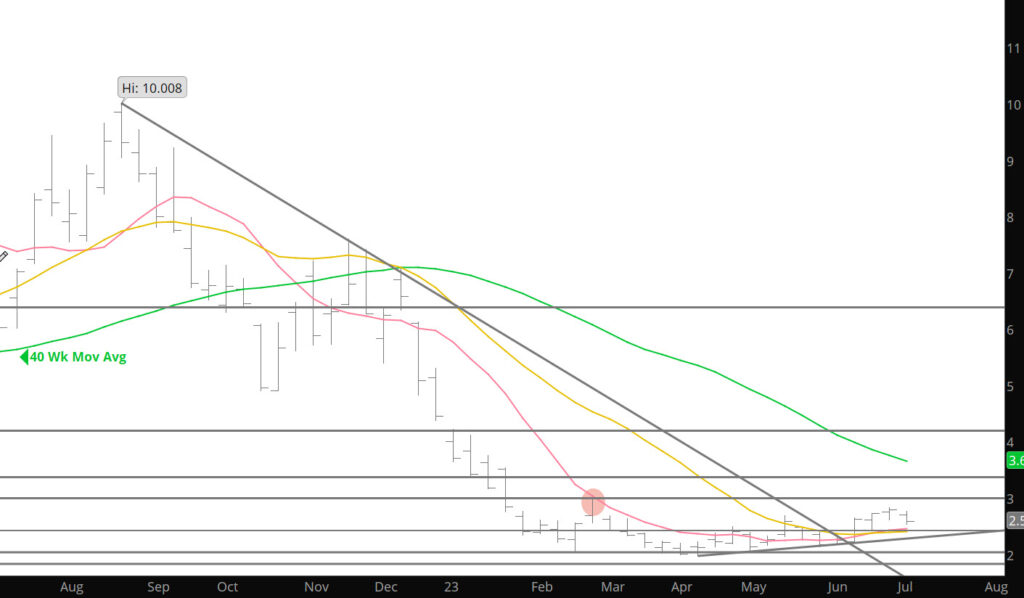
Weekly Continuation

Declines commenced prior to holiday and continued through the week beginning, to test support areas around the $2.52 – $2.57 area. August found support at a variety of moving averages on the continuation charts and its own. On Friday the continuation 20 – day SMA was $2.563, on the August chart the 50 – day was $2.553, the 10 – week, $2.573. Just prior to the close the prompt traded through all those closely watched short – term technical support levels with very low volume (average daily volume this week was +/- 256,000, Friday’s estimate 255,000, about 100,000 contracts less than last week’s average and well below the 30 and 50 – day averages) but managed to recover enough to close above them. In addition, August held above its 06/21 reversal day low ($2.527), but the buying twelve sessions ago that was sufficient to trigger a daily reversal higher was absent . Even with August’s modest week ending recovery the close was below last week’s low, which readers may recall gives rise to a presumption that whether when the market reopens or later in the week, lower trade should be expected.

Typically, after a decline from a pre – Independence Day high prompt gas trades to a low during the second or third week of July before rallying. In bull market years the low is often earlier, in bear market years later. Given that neither characterization is currently applicable, prompt gas is, likely, confined in a trading range that began to be defined in late January and that August will spend most of its tenure trading between whatever the post – Independence low turns out to be and the late June high. The low end of the range should become defined this week .

Major Support: $2.00, $1.991-$1.96, $1.795-$1.766
Minor Support:$2.52-$2.47, $2.38-$2.26, $2.17
Major Resistance $2.816-$2.836, $3.00, $3.536, 3.59

A New Month but History Still Working
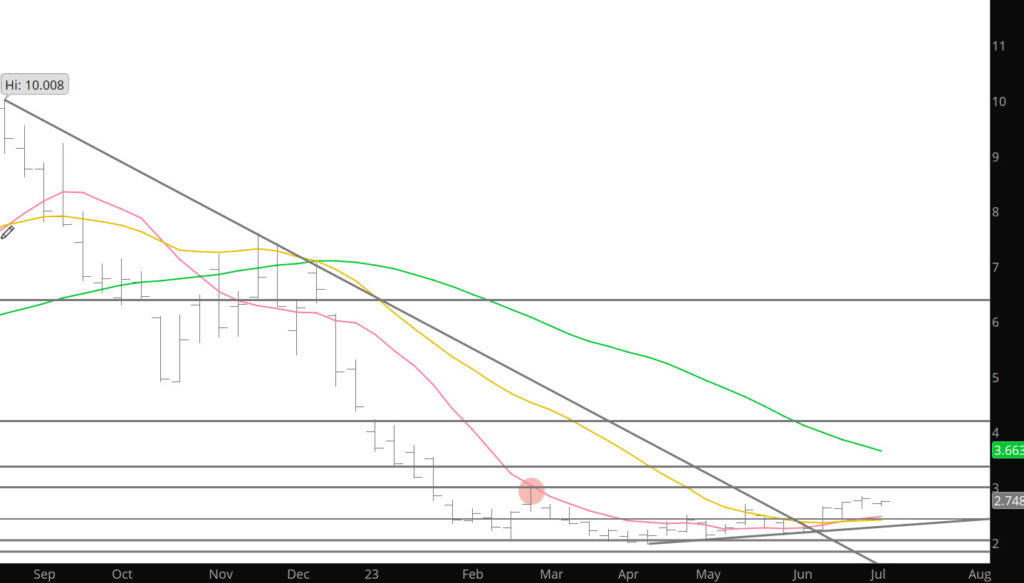
Weekly Continuation

A note about the charts– having light volume and not working — the charts represent the trade from Monday and Tuesday in the data.

Prompt gas has consistently traded a mid – summer high during the sessions leading into the Independence Day holiday and or just occasionally a day or so after, before declining to a mid – July low. Either expiring July’s trade to $2.839 on 06/28 or new prompt August’s recovery to $2.828 on 06/30 on rather mediocre volume, fit the expectation of pre – holiday high. This does not exclude the possibility that August can’t blow through the June high on the way to test $3 and the March high at $3.027, but I am not convinced that action is coming. The average decline for the Independence Day declining seasonal, over the last ten years is about 13%, the last five years about 16%. Before the pre – holiday rally on Thursday and Friday August had fallen $.32/dt (11%) from its 06/26 high…perhaps early discounting of expected holiday weakness, but seasonal lows prior to the beginning of July have only occurred a couple of times in the last twenty years.

An average decline from the June high suggests a target of $2.40 – $2.50 which also just happens to be the value of a violated declining trend line drawn from the March and highs (currently $2.467 and falling about .03/wk). This was the key break out area discussed a few weeks ago.

You may recall that during late Q1 and early Q2 during the declines and following the March low, several requirements were discussed that if met would strongly suggest that the long downtrend from the August ’22 high was complete. First was that the gas market would need to demonstrate growing sponsorship at a higher low, as discussed here periodically, the April low was higher than March, May higher that April and now June higher than May. Secondly, prompt gas needed to test, trade through and close above the trend line drawn from the August – November – December highs (discussed here as the break out area). During week ending 06/09 prompt gas traded an extraordinarily narrow range while testing that declining resistance AND support rising from the April – May lows. The following week prompt July traded through the downtrend defining trend line, closed above it and did so with a substantial increase in volume. Third, the prompt had to follow through to the upside with declining open interest, indicating that institutions with a substantial short position were throwing in the towel. Since the close of June 6th ($2.262) through the close of June 27th ($2.763) the total number of contracts outstanding fell 157,853 contracts. That’s a lot and certainly qualifies as short covering pure and simple. The last requirement,and one that would suggest a new uptrend is beginning), is that volume and open interest increase along with price. Don’t expect that one for a while because prompt gas remains in a trading range that has confined successive prompt contracts since late January remember, just because the requirements for the end of a long – term down trend have been met does not mean that something similar to the upside has begun. Expectations are that there will be multiple short – term uptrends and downtrends within the confines of that trading range during Q3. The gas market is in a state of flux between a substantial group of participants that believe gas prices will be low forever (they speak about over supply and storage surpluses) and others like this analyst that comment that would be tooo easy. Take a look at the monthly chart of August gas (below). We have previously discussed that “outside” months are rare. There were a couple last summer and another one in March but can’t find any other period over the entire history of natural gas trading where there were three within a nine month period. It is not a coincidence that extreme volatility occurs near turning points. The chart below shows that of the last four months, trade during three of them has been through both the prior month’s extremes. That illustrates uncertainty on steroids.
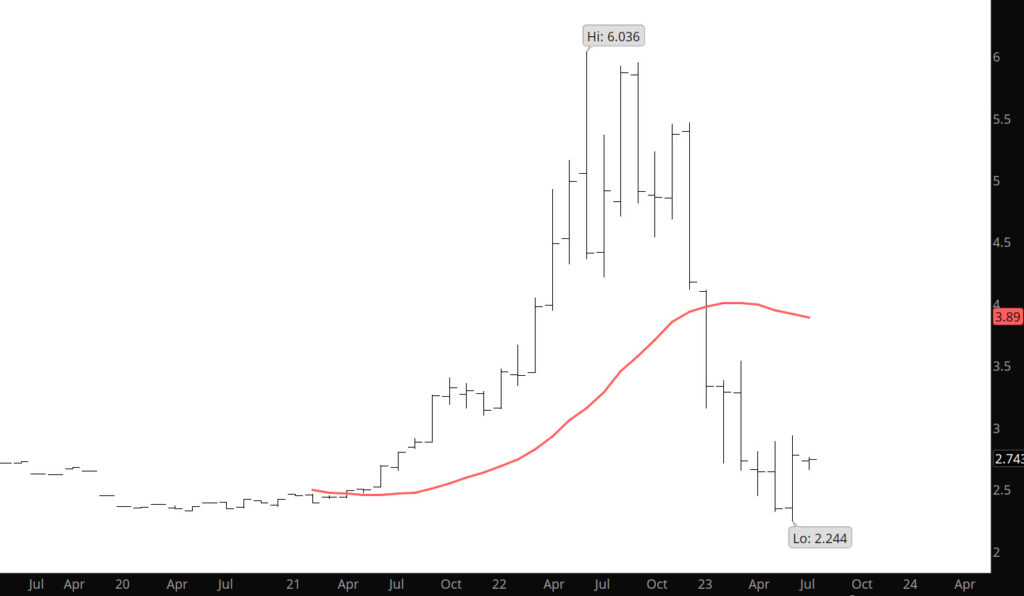
Monthly August Contract

Not suggesting that prices are headed back to $10 in the near term, but the down trend that has held the market since last fall seems to be slowly correcting its bias.

Major Support: $2.00, $1.991-$1.96, $1.795-$1.766
Minor Support:$2.47, $2.38-$2.26, $2.17
Major Resistance $2.816-$2.836, $3.00, $3.536, 3.59

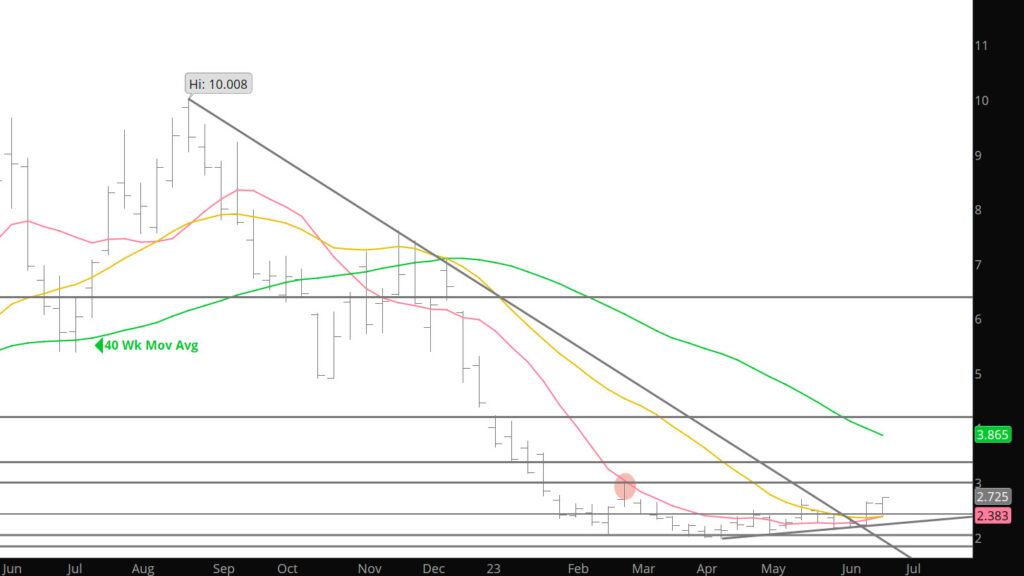
Bias Change Confirmed
Weekly Continuous

Last week, price action confirmed the previous speculated bias conversion to a bullish market with a couple of declines to support areas and finding buyers prior to achieving the support levels. In the Daily a series of higher lows confirm the Weekly chart above showing the series of higher lows in the last three months. Would suggest buying any dips in price action in the expiration week coming — but that in itself is a risky proposition. Perhaps a more conservative approach would suggest buying dips with built in sales prior to the $3.00 area as that will find significant selling on the first approach. Am traveling this week and next so the Weekly and Daily will be brief until events command more commentary. Key to this week is relax and buy dips to support.

Major Support: $2.00, $1.991-$1.96, $1.795-$1.766
Minor Support:$2.47, $2.38-$2.26, $2.17
Major Resistance, $2.707, $2.816-$2.836, $3.00, $3.536, 3.59

To read The Daily Call you must be a subscriber (Current members sign in here. ) Start your subscription today.

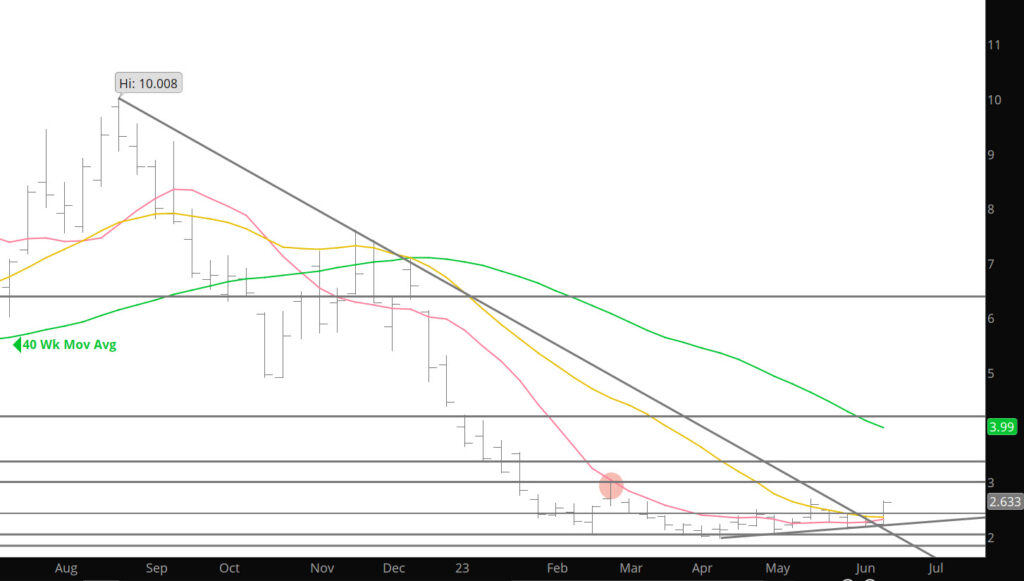
Bias Change
Weekly Continuous

I have been dancing around the potential of a bias change occurring the gas market for a couple of weeks with the series of higher lows over the last two months, volume increasing on the positive trade days, increase in open interest in rallies and the breakout of the resistance zones that have held the market rallies for three months. Some of those elements came to fruition last week with break out above resistance in the high $2.40’s and the ensuing run up to the highs from earlier in Q2 on the continuation charts. Some of the buying was clearly short covering as the resistance areas were penetrated.

With the well defined support zone at $2.00 and below the last three months have provide a consolidation base for the current run. Now the question will be how far does the rally run prior to expiration. May high of $2.685 up to the highs for the July contract at $2.707 to $2.816 will likely provide to much selling for prices to extend much beyond.

To read The Daily Call you must be a subscriber (Current members sign in here. ) Start your subscription today.